
Learn the 20 amino acid one-letter and three-letter codes with a quick reference, D/E/N/Q comparisons, simple memory cues, and five practice questions.
Amino Acid Code Mnemonics
Start with the 11 codes that match the first letter of the amino acid name. Then focus on the nine exceptions. The memory cues below are learning aids; they are not all historical reasons for assigning the letters.
The 20 codes at a glance
| Amino acid | Three-letter | One-letter | Memory cue |
|---|---|---|---|
| Alanine | Ala | A | First letter |
| Cysteine | Cys | C | First letter |
| Aspartate (aspartic acid) | Asp | D | Pair D with E: the shorter acidic side chain |
| Glutamate (glutamic acid) | Glu | E | Glutamate; one extra CH₂ compared with D |
| Phenylalanine | Phe | F | “Ph” sounds like F |
| Glycine | Gly | G | First letter |
| Histidine | His | H | First letter |
| Isoleucine | Ile | I | First letter; Ile, not “Iso” |
| Lysine | Lys | K | K sits just before L; L is leucine |
| Leucine | Leu | L | First letter |
| Methionine | Met | M | First letter |
| Asparagine | Asn | N | Asparagine; Asn |
| Proline | Pro | P | First letter |
| Glutamine | Gln | Q | “Q-tamine” as a personal memory cue |
| Arginine | Arg | R | arginine |
| Serine | Ser | S | First letter |
| Threonine | Thr | T | First letter; distinguish Thr from Trp and Tyr |
| Valine | Val | V | First letter |
| Tryptophan | Trp | W | A bulky W for its double-ring side chain |
| Tyrosine | Tyr | Y | tyrosine; T is already threonine |
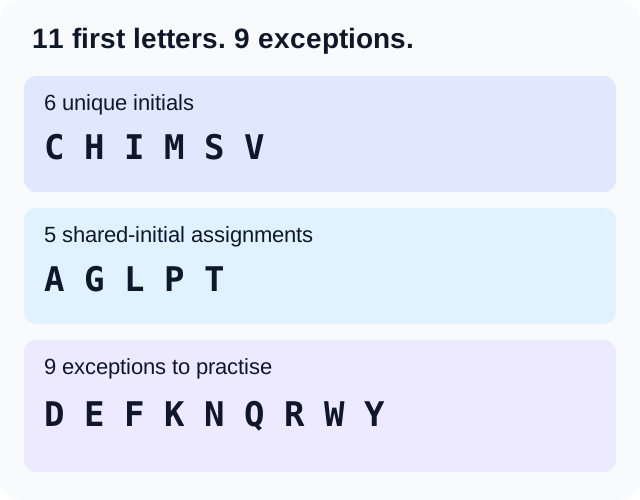
Six names have unique initials: C, H, I, M, S and V. Five others use a shared initial: A, G, L, P and T. That leaves nine codes to practise separately.
Distinguish D, E, N and Q
Learn these as two related pairs instead of four unrelated letters:
- D / Asp and E / Glu have acidic side chains. E has one more CH₂ group than D.
- N / Asn and Q / Gln are the corresponding amides. Q has one more CH₂ group than N.
- In the three-letter codes, Asp/Glu identify the acids and Asn/Gln identify the amides. Notice the final n in both amide abbreviations.
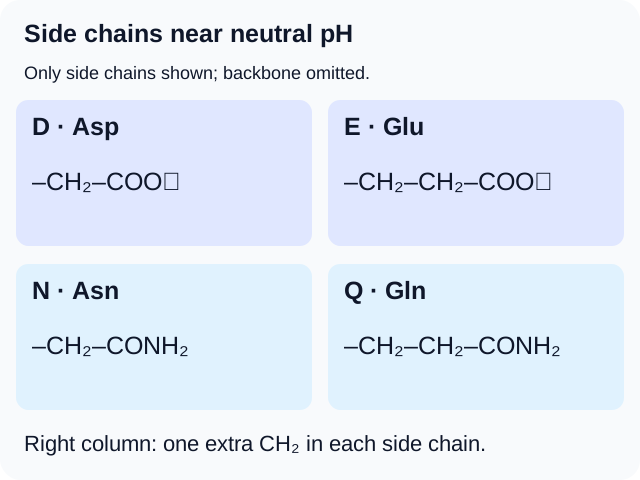
The diagram shows only side chains, attached to the same amino acid backbone. Near neutral pH, the D/E side chains are usually negatively charged; N/Q side chains are uncharged. The CH₂ comparison is a useful cue, not a claim about why the letters were chosen.
Remember K, F, R, W and Y
K versus L: leucine uses L; remember lysine as the neighbouring letter K. Keep the three-letter forms alongside them: Lys = K and Leu = L.
F and R: “Ph” in phenylalanine sounds like F; the R in arginine is another useful sound association.
W versus Y: Trp = tryptophan = W; Tyr = tyrosine = Y. Associate the bulky W with tryptophan’s fused double-ring side chain, and find Y inside tyrosine. Do not treat “WHY-rosine” as its pronunciation.
Test yourself
Cover the table, answer these questions, then check below:
- What are the one-letter codes for Asp, Asn, Glu and Gln, in that order?
- Convert Lys–Leu–Trp–Tyr to one-letter codes.
- Expand F–R–M to three-letter codes.
- Which has the longer side chain: aspartate or glutamate?
- Which three-letter code means isoleucine: Ile or Leu?
Answers: 1. D–N–E–Q. 2. K–L–W–Y. 3. Phe–Arg–Met. 4. Glutamate, by one CH₂. 5. Ile; Leu is leucine.
Practise both directions with the Amino Acid Converter. For sequence notation and background, read the one-letter code guide.
Sources and related learning
The IUPAC–IUB nomenclature recommendations, section 3AA-21.2 document the code assignments. They describe the unambiguous initials, the shared-initial assignments, F/R sound associations and the bulky W association. K and Y were selected from remaining letters for their alphabetical proximity to the names’ initials. The additional cues in this article are optional study aids.
Looking for PURE As Gold or CUT the Py? Those describe nucleotide bases, not amino acids. See purines versus pyrimidines for that separate topic.