
Dihybrid Cross Calculator
Use this dihybrid cross calculator for two independently assorting genes. The AaBb × AaBb preset creates the classic 4×4 Punnett square.
Punnett square results
Illustrative symbols for each gene, not real species predictions. Pink = dominant, blue = recessive, purple = intermediate, pink + blue = codominant. Zoom in or expand large grids to see pictures.
| P1 ↓ P2 → | AB | Ab | aB | ab |
|---|---|---|---|---|
| AB | ||||
| Ab | ||||
| aB | ||||
| ab |
Colors follow the selected view. Click a cell or result to highlight its group; labels and probabilities identify each group.
Analysis
Homozygous at every locus: 4/16 (25%)
Heterozygous at one or more loci: 12/16 (75%)
Parent 1 gametes · 4
Each gamete has probability 1/4.
Parent 2 gametes · 4
Each gamete has probability 1/4.
The grid shows the possible combinations for this model; it is a probability model, not a guarantee for one individual offspring.
Visual guide: from four gametes to a 4×4 grid
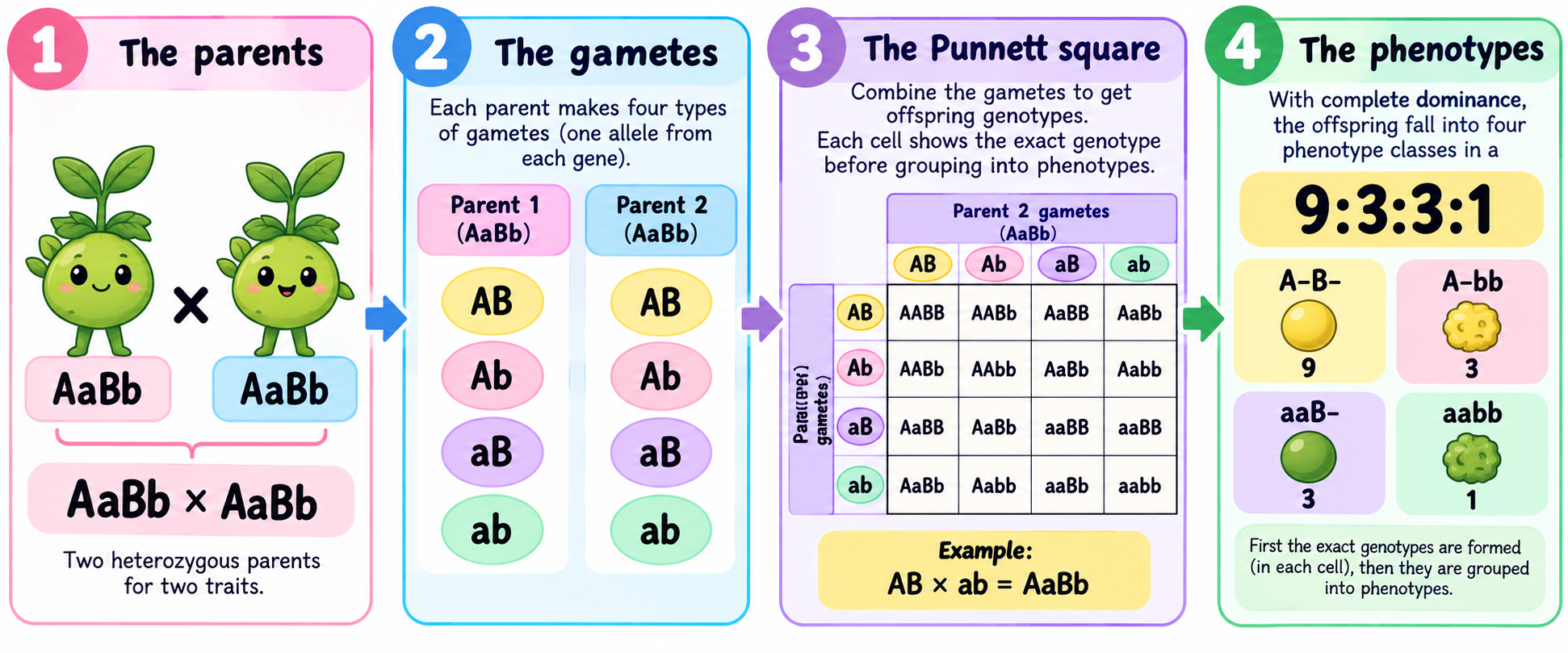
Those groups correspond to 56.25%, 18.75%, 18.75%, and 6.25%. The classic ratio assumes independent assortment and complete dominance.
How to calculate a dihybrid cross
The 4×4 grid has 16 equally likely gamete combinations when both parents are AaBb.
- 1Split AaBb at both loci. Each parent can contribute A or a and B or b.
- 2List the four gametes: AB, Ab, aB, and ab. Put one list on each axis.
- 3Combine row and column gametes. For example, AB × ab produces AaBb, not A– B–.
- 4With complete dominance, group the 16 exact cells into A–B–, A–bb, aaB–, and aabb to obtain 9:3:3:1.
Checks for an AaBb × AaBb cross
1. Each parent produces AB, Ab, aB, and ab when both loci are heterozygous.
2. The 4×4 grid has 16 equally likely cells; AB × ab is the exact genotype AaBb.
3. The 9:3:3:1 phenotype pattern requires independent assortment and complete dominance.
Linked genes can change the dihybrid ratio. The 9:3:3:1 pattern should not be used for sex-linked, blood-type, or complex polygenic traits.